At three northern Vermont farms, women are turning fresh milk into distinctive cheeses — and inherited grit into a future.
Written by Hannah Howard
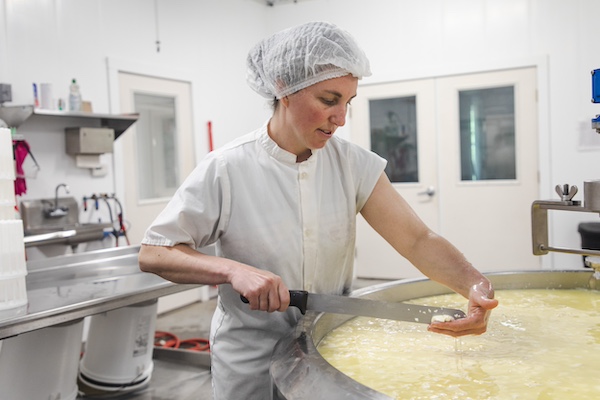
Melanie Webb, Cheesemaker and Owner of Stony Pond Farm
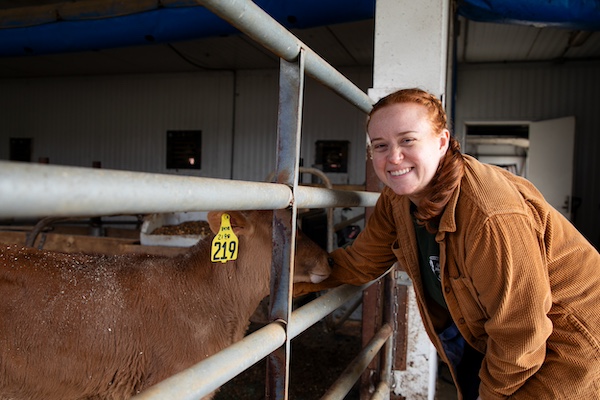
Kayleigh Boucher, Cheesemaker at Green Mountain Blue Cheese
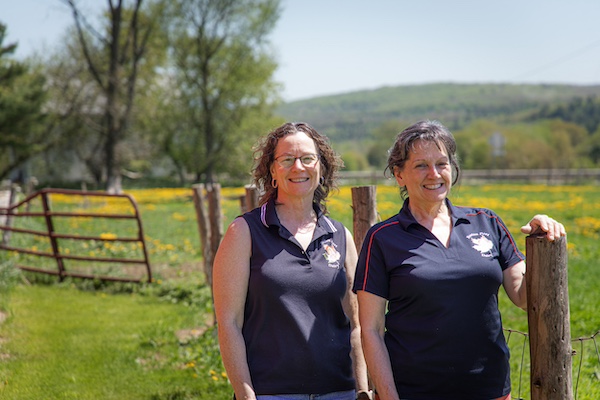
Susan Blouin (Soap maker) and Anne Doe (Cheesemaker), Owners of Boston Post Dairy
At Stony Pond Farm in Fairfield, milk travels from the cows into Melanie Webb’s vat still warm from their bodies. A short drive north, at Green Mountain Blue Cheese in Highgate Center, Kayleigh Boucher makes cheese alongside morning milking, diverting milk from the bulk tank before it has ever been cooled or reheated. And at Boston Post Dairy in Enosburg Falls, sisters Anne Doe and Susan Blouin have helped turn a family dairy into a many-layered enterprise of cheese, goat-milk soap, maple syrup, and a farm store.
Their farms are different: first-generation and centuries-old, seasonal and year-round, cow and goat. But together, these women tell a story that feels especially at home in Franklin County, where dairy is not merely a link to the past. It is a living, demanding business—and survival has always required reinvention.
Boston Post Dairy: Building Something New from Scratch
At Boston Post Dairy, reinvention is a family inheritance. Anne and Susan grew up in a family of 15 children: 11 boys and four girls. Everyone had barn chores. The older children helped care for the younger ones. Work was not an extracurricular; it was how a family that size functioned.
Their father called Boston Post the “Girls Farm,” and it was the daughters who built its next chapter. When the family began making cheese in the late 2000s, they did not arrive with generations of recipes or a polished business plan. They learned.
Their first batch offered a memorable lesson. They poured the curds into store-bought cheesecloth, only to watch them slip right through. A mother-in-law made an emergency run for fabric and stayed up sewing muslin draining bags for the next day. From that shaky beginning came an award-winning line that includes fresh chèvre and the Alpine-style Eleven Brothers—named, naturally, for Anne and Susan’s 11 brothers.
“We started with a huge loan and no idea who we were going to sell our cheese to,” Anne said. So they made it, peddled it, found customers, and kept going.
The sisters are frank that hard work alone is not a business model. “You can’t just keep working harder to make more money,” Susan said. “You have to really think outside the box.” That means watching costs, trying new products, and responding to problems with the confidence their parents instilled in them: We can figure this out.
Green Mountain Blue Cheese: Carrying a Legacy Forward
Kayleigh Boucher is inheriting an even deeper farming history, but she is finding her own way into it. Her family has raised dairy cows for 14 generations. As a child, she adored the farm, waking at five in the morning to milk with her uncle Dan, collecting eggs, and greeting the animals.
She once imagined taking over the dairy. By the time she graduated from UMass Amherst with a degree in sustainable food and farming, she knew she did not want the relentless schedule of running the entire operation. Still, she returned to see whether there might be a place for her.
There was. Her aunt had stopped making Green Mountain Blue Cheese during the pandemic, and Kayleigh helped restart production. What began as a practical role became a calling. Her aunt spent years teaching her the recipes and rhythms of the make; Kayleigh is now working toward taking over the cheese business as the older generation retires.
Green Mountain makes only blue cheese, but Kayleigh is quick to point out how expansive that category can be. Boucher Blue is bold, creamy, and crumbly; Gore-Dawn-Zola is mild, nutty, and buttery, the cheese she offers to people convinced they do not like blue; Madison Blue is drier, longer-aged, and crystalline. Together, they make the case for an all-blue cheese board—far beyond the anonymous crumbles scattered over a salad.
For Kayleigh, the magic happens before any of those distinctions emerge. She adds rennet to a vat of warm milk, waits, and returns to find the liquid transformed. Then she cuts the curd.
“It goes from really a liquid to a solid,” she said. “It’s very cool.”
Stony Pond Farm: Crafting Cheese from Place and Season
Melanie Webb understands that fascination with transformation. Before Stony Pond, she lived in New York City and worked in photography and the art world. She met her future husband, Tyler, at the Burlington Farmers Market, where he was “the meat guy” grilling burgers at nine on a Saturday morning. Within a year, she had traded the city for a rundown Vermont dairy farm.
For roughly 15 years, the Webbs rebuilt it piece by piece: clearing the barn, restoring pastures, laying water lines, and building fences and cow lanes. When they were finally ready to add value to their milk, Melanie learned cheesemaking from friends at a nearby goat dairy.
The resemblance to darkroom photography surprised her. In a darkroom, an image slowly emerges on paper in a tray of chemicals. In cheesemaking, curds emerge from whey, and something solid, edible, and full of possibility appears where there had been only milk.
At Stony Pond, that transformation is inseparable from the farm. The dairy is seasonal, and the cows move to a fresh paddock every 12 hours. Their milk changes with the weather, forage, butterfat, and protein, so Melanie does not force it into rigid consistency. She makes cheeses designed to express the season.
She maps where the cows grazed for each batch, adding notes about heat, rain, dandelions, and wildflowers. Her cheeses—Swallow Tail Tomme, Tom-Tom, and Black Capped Cache—are named for birds found on the farm. The swallows nesting along the cow lanes swoop through the air eating flies; the chickadees cache seeds for winter, just as cheese allows Melanie to preserve summer milk for colder months.
None of this is easy. All three women talk about wearing every hat: cheesemaker, marketer, salesperson, bookkeeper, farmer, and, often, mother. They talk about rising costs, exhaustion, isolation, and the difficulty of finding reliable labor. Value-added dairy offers more control than selling fluid milk, but it also means creating the product and then persuading someone to buy it.
Community Is the Secret
What helps is community. Melanie and Kayleigh both describe Vermont cheesemakers opening their doors, sharing advice, and treating a new producer not as a threat but as another person worth helping. Farmers markets give Kayleigh a break from the solitude of the cheese room. Positive feedback reminds Melanie that her cheeses travel farther than she does.
Perhaps that is what is in the water in Franklin County: not some romantic refusal to change, but a deep conviction that continuity requires change. These women are not preserving dairy by keeping it frozen in time. They are carrying it forward by learning new skills, building new businesses, honoring what works, and bravely remaking what does not.
The milk may arrive warm from the cow. Everything that happens next is tenacity and imagination.