What was your path to becoming a cheesemaker?
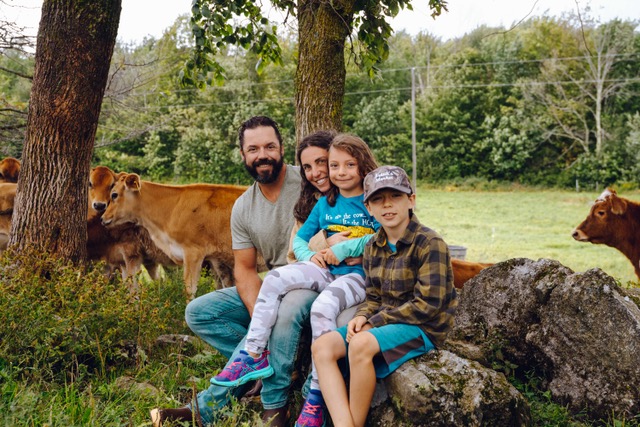
My husband Tyler and I are both first-generation farmers. He got here first, buying a rundown dairy farm. He was on the lookout for a diamond in the rough that he could see the potential for. It wasn’t actively being farmed when he moved here, and the barn was full of junk. He started with beef cows and then the dairy was added once the pastures got up to a level that could support dairy cows.
I joined him here 17 years ago. We were just milking cows and building our farm; we wanted to do something value-added but needed to get things together first. We didn’t have the infrastructure. We didn’t have the money. We didn’t have the knowledge. So, we spent a lot of time just building the farm, building all the cattle lanes, the fences, the water pipe—bringing the pastures back to better health and figuring out how to raise good, healthy cows. Every year we did more, constantly improving and trying to build our business. Then as things evolved, we got to the point where we could think about making cheese or some other value-added product.
We were trying to figure out how to continue to build financial stability through dairy farming. We were open to new ideas and opportunities, wanting to diversify rather than just milk more cows, which is often what dairy farmers do. When they need more money, they just add more cows. But that creates a cycle that doesn’t always solve the problem; it can keep you in the same spot or create different problems.
We were friends with the farmers from Doe’s Leap Farm nearby. They offered to let me come over and make cheese at their facility. I bought milk cans and brought milk over whenever the cheese room was free, and Kristan [Doolan] taught me how to make cheese. I really loved it. I love milk and I love drinking it, but there’s something more magical about cheese—that transformation, the aging process, the flavors that come out, all the different combinations of things that lead to all the different cheeses. After I spent the summer making cheese, we said, “Okay, now we have to figure out how to build a facility at our farm.” We applied for a grant, took out some loans, built a cheesemaking facility, and started making cheese here. That all happened quickly, but it all came together. This was right before and into the pandemic.
Are you and your husband both from Vermont?
Neither of us are. I grew up in Connecticut, outside of New York City. Tyler grew up in Rochester, NY and it was UVM that brought him to Vermont. He has a master’s in agronomy, so that led him to farming. He worked for NRCS [Natural Resources Conservation Service] for a little while, but then it evolved into this.
Did you know each other before he started the farm?
No, we met at the farmers market in Burlington. I had been living in New York City, and came to visit a friend who lived in Burlington. We went to the farmers market—it was 9 in the morning on a Saturday, and I was like, “Why am I awake? Why are we here?” It was a totally different lifestyle from New York City!
Tyler was just bringing beef to the farmers market at that point, and he grilled cheeseburgers. My friend said, “You should get a cheeseburger. They’re really good.” She had bought a lot of meat from Tyler, so she knew him. I ended up getting a cheeseburger and Tyler and I talked. And then my friend played matchmaker a little bit. She had his email and she connected the dots for us and then we ended up hanging out while I was visiting that weekend. We then kept in touch through email and it evolved from there.
What was your professional path prior to meeting the love of your life at a farmers market in Burlington, Vermont?
I was working at a photography retouching studio in the Meatpacking District. I was into photography, into the art world. I was trying to do some documentary photography, and really liked it.
So, you didn’t grow up thinking, “I want to be in farming or cheesemaking…”?
No, but I was starting to get interested in where my food came from. I joined a CSA in Long Island and went out to photograph it. I had also joined a buyer club and was buying raw milk from Pennsylvania. Raw milk was illegal in New York City; it felt like the most illicit thing I’d ever done! So I was starting this journey a little bit in terms of food—where my food comes from, the quality of the food, knowing what raw milk is, etc.
And I guess I was open for a change. I grew up in the suburbs; I didn’t want to live there. Then I spent eight years in New York City. I really enjoyed it in my 20s, but at that point I was 29 and didn’t see myself living there forever. I didn’t necessarily want to settle down and try to raise a family there; it’s such a daily grind and struggle financially. Then I met Tyler and was really open and intrigued by the idea of rural living and something totally different. It felt like a new, exciting adventure to become a part of.
Do you have a favorite aspect of cheesemaking?
My favorite part is the transition that happens. As I said, I really like photography, and I really loved dark room photography back in college and in my early 20s. When I first moved to New York, you could rent dark rooms. They were community places where you’re developing your film and using enlargers and looking at pictures together. I really loved the tangibleness of all that. But then something got lost for me when everything became digital. I was trying to love it—and what it could do was amazing—but I just didn’t love sitting in front of a computer manipulating pixels. My passion was not there.
Broadly, I was also drawn to farming because it’s a really tangible thing. I love milking the cows and then knowing there’s milk in the bulk tank. I’ve done something. I can drink it. I can see what I accomplished. It’s physically there and it feels like rewarding work. And you’re providing food for yourself, your family, or the greater public. Along those same lines, cheesemaking unexpectedly reminded me of something that was lost for me in photography. When you start out, the milk’s just a liquid…and then you add your rennet, and you cut the curd, and then the curds emerge from the whey. It reminds me of that process in the dark room when you’re developing the picture and you put the paper in the developer and the image emerges in the chemical. It’s this magical moment of: “What’s it going to look like? What’s it going to be?” I got that same feeling in making cheese. And that was really exciting for me to have that come back where I wasn’t expecting it. I didn’t know that was going to be there.
There’s so much creativity in cheesemaking, but it’s also science. It has so many different aspects that engage me. So, my favorite part is that transition and creating something that I and a lot of people can enjoy. I can go into the aging room and see all the cheese I’ve made, and that’s gratifying and rewarding.
What is the most challenging aspect of being a cheesemaker?
I guess the challenge is just balancing all the different responsibilities and the workload. Cheesemaking can be so consuming and the more attention you give the cheese, the better it is. So, sometimes it’s just hard to know that you could be doing more and should be doing more. Maybe if you did, your cheese would be better, but you can’t or you need to do something else. Plus just having a small farmstead operation and wearing all the hats: marketing the cheese, making the cheese, then paying the bills and managing the inventory.
What does your typical day look like?
I wake up and go to the creamery at 6:00 to get set up to start receiving milk. I make cheese while the cows are getting milked and the milk’s just flowing into the cheese vat, still warm from the cow. The vat gets filled until around 7:00, and then it’s on to culturing the milk, renneting, cutting, doing the whole cheesemaking process, hooping, flipping, all that stuff. I’m usually in there until around 11:30 for the cheese make. When everything is cleaned up, I take a break, get something to eat, and do anything that has to get done right away. Then I go back in the middle of the afternoon to do another flip. It’s the middle of the days where I can either do stuff in the garden or pay bills or do laundry or do something with the kids. And then at 4:00, I usually milk. I go get the cows from the pasture, turn on the sanitizer, get ready for milking, and then milk until 7:00 or so. Then I have some dinner, relax for a minute, go to bed, and do it all over again.
Do your husband and kids have any regular duties as part of your whole cheesemaking process?
Tyler milks in the mornings and I milk in the afternoons, generally speaking. That works well…he’s milking when I’m making cheese and then I get to milk in the afternoons. I like being in touch with the cows and being a part of that. Our kids help usually with afternoon milking, feeding calves, setting up a paddock, and other miscellaneous things. They’re starting to have more of an impact, really contributing and making things go faster. My daughter comes into the cheese room more and she’ll help me vacuum pack or pack orders or do a flip or take cheese out of the brine. My son’s not usually willing to get himself cleaned up enough for me to let him through the door. Same with my husband, but he’ll do deliveries and things like that.
Are you primarily making cheese by yourself? If so, what do you do for social contact with others when you’re not making cheese?
I do have someone working with me in the creamery now, which has been nice. A guy who worked for us a while ago when we just milked had gone on to work in brewing. He came back around and was interested in cheesemaking. He started working for us last year and really enjoys it; there’s a lot of similarity between brewing and cheesemaking! So, this is the first time I’ve had someone alongside me for the make and as a result, we’ve been able to make more cheese. It’s fun now having someone to talk to and joke around with while we’re making cheese. In addition, we have a new couple living here where the guy works for us and he just milks. So Tyler milks with him a lot in the mornings and I milk with him in the afternoons.
Those are just two people outside of my immediate family whom I get to see every day, talk to, and interact with. And we have two Airbnbs on the farm, so sometimes I end up talking to or hanging out with different Airbnb people. They’ll come find us at milking and want to see what we’re doing. We’ve had people from other countries stay here, so it’s fun to get an international flare through the guests. As for when I can spare some time, there’s a group of women who do yoga every Monday on someone’s porch in the summer, so I try to go to that whenever I can.
What’s the best piece of advice that you’ve ever received from another cheesemaker?
Laini [Fondilier] once told me something that has stayed with me: “Hard cheese is hard. Hard to make and hard to make money.” Whenever I’m struggling with something, I just remember Laini saying, “Hard cheese is hard” and it makes me laugh.